Longford based, nationwide supporthello@purpletree.ie+353 1 800 787 333

Right courses, ready records

Occupational health & safety training that fits the work

Section 10 of the Safety, Health and Welfare at Work Act 2005 puts the duty to train your people squarely on you, and it is meant to fit the real risks of the job. PurpleTree delivers certified occupational health and safety training built around your workplace, from manual handling and fire safety to first aid, with the records kept current for HSA inspection. We are a Longford-based team serving Irish employers directly.

Occupational Health and Safety Training Ireland

Stay on the right side of the law.

Why OHS Training Is a Legal Requirement

Under Section 10 of the Safety, Health and Welfare at Work Act 2005, every Irish employer must provide the instruction, training and supervision needed to keep employees safe, and specific duties such as manual handling sit under the General Application Regulations 2007.

Beyond meeting the law, effective training equips your people to spot hazards, prevent accidents, and respond when something goes wrong. The business case lines up with the legal one. For the bigger picture of what the Act expects, read our guide to employer health and safety obligations or the full health and safety scope.

Legal compliance

Meet your duties under the 2005 Act and the 2007 Regulations, and stay ready for HSA inspection.

Reduced risk

Fewer workplace accidents and injuries, and lower costs when an incident is avoided rather than investigated.

Better productivity

Safe, confident teams work more efficiently, with stronger morale and less disruption.

Lower costs

Reduced exposure to compensation claims, insurance premiums and lost working days.

Training matched to the jobs your people do.

The Courses Irish Workplaces Most Often Need

We cover the legally required and best-practice health and safety courses an Irish SME typically needs. Which ones apply to you comes out of your risk assessment and safety statement rather than a one-size list, so we map the catalogue below to the roles that actually need each one.

Certified manual handling

Safe lifting technique and T.I.L.E.O. risk assessment under the General Application Regulations 2007, the most commonly required course of all.

Fire safety and warden training

Emergency response, evacuation procedure and the duties of a nominated fire warden.

First Aid Response (FAR)

PHECC-accredited training for your designated occupational first aiders, typically refreshed every two years.

DSE / VDU assessor training

Ergonomic workstation setup and display screen assessment for office and hybrid staff.

Working at height and confined spaces

Specialist training for higher-risk tasks, matched to the controls in your safety statement.

Sector and role-specific courses

Additional courses scoped to your industry and the particular hazards your people face day to day.

Flexible delivery options for health and safety training

Run to suit your site and your schedule.

Flexible Delivery Options

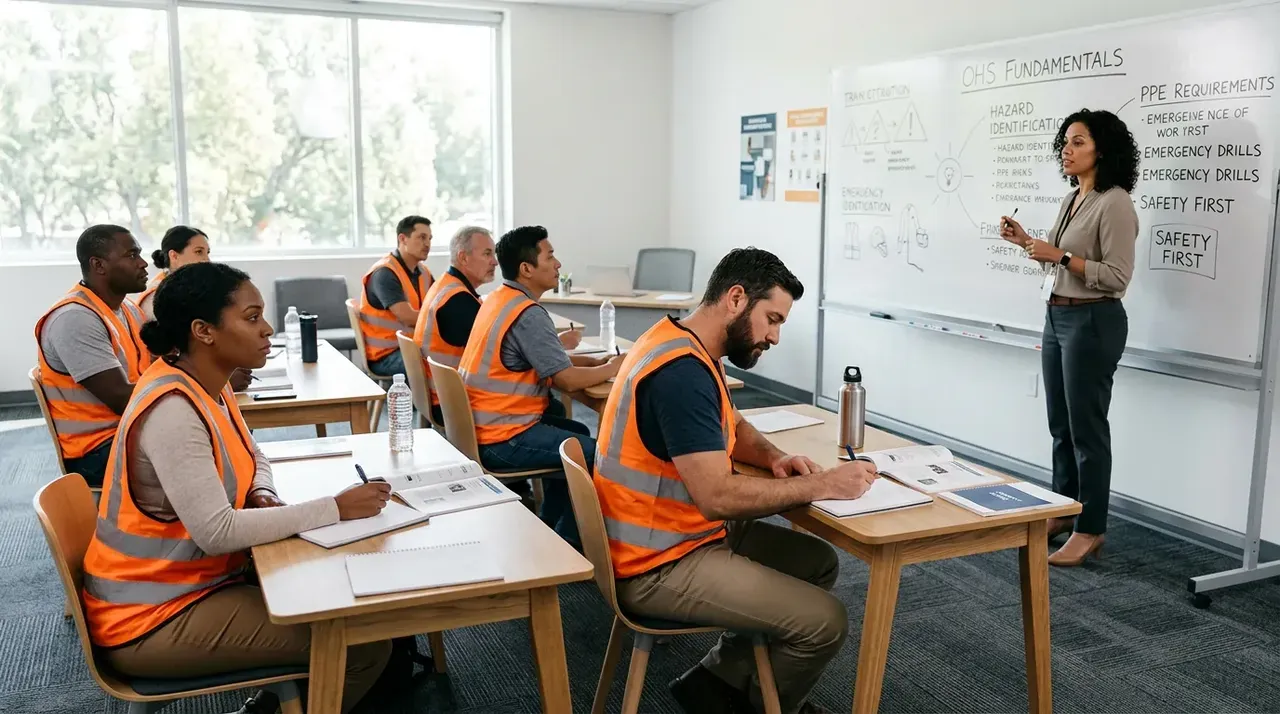
Training is delivered to suit how your business runs, with minimal disruption to operations. Practical courses such as manual handling and fire safety usually land best on-site, where people train on their own equipment and in the surroundings they actually work in.

  • On-siteDelivered at your workplace for hands-on, environment-specific learning on your own equipment.
  • VirtualInteractive online sessions for remote, hybrid or dispersed teams.
  • BlendedOnline theory modules combined with in-person practical assessment where the course requires it.
Discuss your delivery options
Training needs analysis for your workforce

We find the real risks before booking courses.

A Training Needs Analysis Comes First

The right starting point is not a course list, it is your actual risk. PurpleTree runs a Training Needs Analysis by reviewing your safety statement, risk assessments and incident records to identify the training that is legally required for your roles and the training that is simply advisable. The result is a prioritised plan, so spend goes where the risk is. Where your documents need work before the training plan can stand on them, our health and safety audit closes those gaps first.

  • Reviewing the legal health and safety training requirements for your sector
  • Analysing your risk assessments to pinpoint the specific training gaps
  • Building a prioritised, costed training plan for your team
Request a training needs analysis
Training records and certification management

Never get caught with an out-of-date qualification.

Training Records and Certification Management

Accurate training records are how you show compliance when an HSA inspector calls or an incident is investigated, and they are usually the first thing asked for. PurpleTree provides attendance registers and certificates for every course, advises on refresher periods such as manual handling at roughly three-year intervals and First Aid Response every two years, and through our health and safety documentation service helps you keep all of it current and easy to produce.

  • Clear training documentation kept ready for inspection
  • Guidance on refresher intervals so certifications never lapse unnoticed
  • Secure, auditable management of every training record
Sort your training records
Why choose PurpleTree for OHS training

Built for Irish law and Irish worksites.

Why Choose PurpleTree for OHS Training

PurpleTree delivers occupational health and safety training that is compliant, practical and tailored to your actual risks, not adapted from a generic UK template. Our trainers know Irish workplaces and Irish law, and the training plan sits inside the wider compliance picture rather than standing alone. For employers who want health and safety handled alongside the rest of their people obligations, training is built into an outsourced HR retainer rather than billed as a separate extra. See how we price ongoing HR support before you book.

  • Qualified trainersInstructors with practical, current knowledge of Irish workplace health and safety.
  • Tailored programmesTraining built around your organisation's specific risks, not a fixed off-the-shelf course.
  • Compliance focusCourses that meet Irish legal requirements and the relevant industry standards.
Speak to our team
Building a lasting safety culture

Knowledge that stays long after the session ends.

Building a Lasting Safety Culture

Formal courses start the job, but a safety culture is what keeps it going between training days. PurpleTree helps you embed visible management commitment and give employees a clear route to raise concerns, so safe working becomes the everyday norm. Equipping your line managers to reinforce it matters most, which is where our manager training supports the wider effort.

  • Reinforcing training through regular toolbox talks
  • Encouraging proactive hazard and near-miss reporting from staff
  • Integrating health and safety into daily operations and performance reviews
See all health and safety

Take the next step on health and safety training

Tell us your headcount, your sector and the work your people actually do. We will run a training needs analysis, scope the right occupational health and safety training for your business, and quote it in advance. For employers on an outsourced HR retainer, health and safety support is already built into your monthly cover.

Talk to us about OHS training

Free 5-minute HR Health Check

See where your business stands before the WRC does

Answer 40 straightforward questions on contracts, working time, pay, leave and policies, and get a clear read on where your compliance gaps sit and what to fix first.

Take the free HR Health Check

Common questions from employers

Yes. Section 10 of the Safety, Health and Welfare at Work Act 2005 requires every employer to give employees the instruction, training and supervision they need to work safely. The duty applies from your first employee, not your fiftieth, and it is meant to be specific to the actual risks of the job. Training is normally given at induction, when a person changes role or task, when new equipment or risks are introduced, and at sensible intervals after that. For the wider picture of what the Act asks of you, see our guide to health and safety obligations for Irish employers.
It depends on the work your people do, and the honest answer comes from your risk assessment rather than a generic course list. Most Irish workplaces need manual handling, fire safety and warden cover, and a trained occupational first aider, with display screen equipment, working at height or confined-spaces training added where the tasks call for it. We read your safety statement and risk assessments first, then map the training to the roles that genuinely need it so you are neither under-covered nor paying for courses no one uses.
The General Application Regulations 2007 require employers to provide manual handling training, but they do not set a single fixed refresher interval in law. In practice most Irish employers refresh manual handling training roughly every three years, and sooner where tasks, loads or equipment change, or after an incident or near miss. We help you set a sensible refresher schedule and keep the records to evidence it at inspection.
In most cases yes. The General Application Regulations 2007 require employers to provide adequate first aid based on the size and risk of the workplace, which usually means one or more occupational first aiders trained on a PHECC-accredited First Aid Response course. The number you need rises with headcount, shift patterns and the hazards on site. First Aid Response certification is typically renewed every two years, and we track those expiry dates with the rest of your training records.
Yes. We deliver on-site at your own workplace, virtually for remote or dispersed teams, or as a blend of online theory with in-person practical assessment. On-site delivery is often the most effective option for practical courses such as manual handling and fire safety, because employees train on the equipment and in the surroundings they actually work in, which improves how well the learning sticks.
Yes on both counts. Employees receive certificates on successful completion, and you should keep attendance registers and certificates for every course. Training records are among the first things an HSA inspector asks to see, and they are part of how you show you met your duties if an incident is investigated. We provide the documentation and, through our health and safety documentation service, help you store it so it is current and easy to produce on request.
We scope training to your site, your headcount and the courses your risk assessment calls for, then quote the price in advance so you know the cost before anything is booked. For employers on an outsourced HR retainer, health and safety support is built into the monthly cover rather than billed as a separate extra. See how we price HR support and ask us for a tailored figure.
Training is one of several duties under the 2005 Act, so it is necessary but not sufficient by itself. You also need a current written safety statement, up-to-date risk assessments, proper supervision, and the records to evidence all of it. We look at health and safety as a whole, so the training plan we build sits inside a compliant system rather than standing on its own.

Need support with this?

Book a free consultation and we will scope exactly what your business needs, then put it on a fixed monthly fee with no surprises.