

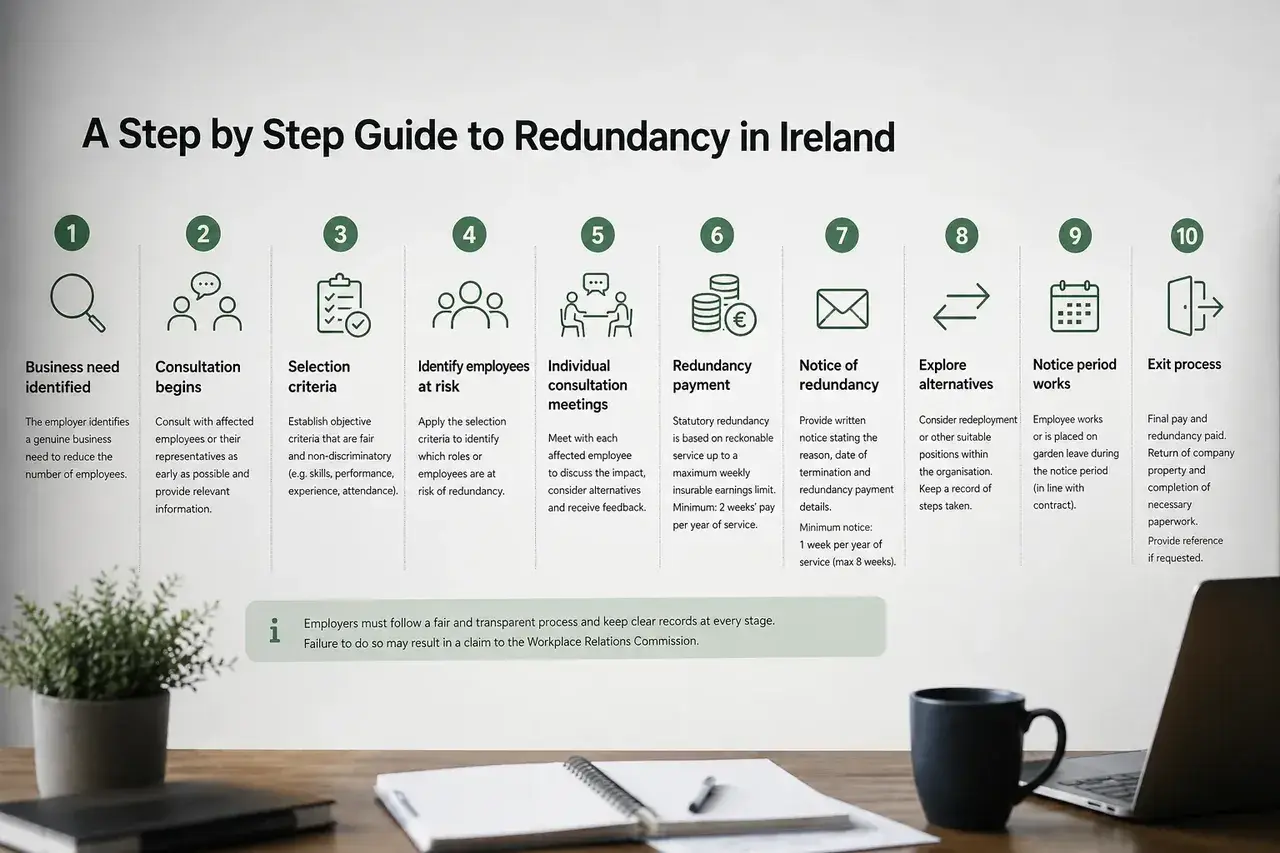
For any Irish employer, navigating the redundancy process in Ireland is one of the most legally demanding situations you will face. Get the steps right and you protect your business; miss a single requirement and you risk a costly WRC claim. This guide walks you through every stage: plainly, practically, and in the correct order. Because a flawed process is the most common reason these dismissals end up at the WRC, many employers bring in redundancy process support for Irish employers before the first at-risk conversation rather than after a claim lands.
Quick Answer: What Is the Redundancy Process in Ireland?
The redundancy process in Ireland requires an employer to establish a genuine redundancy situation, apply fair and objective selection, provide statutory notice, pay statutory redundancy to eligible employees, and issue the required documentation. Skipping any step can render a dismissal unfair, regardless of whether the underlying business need was genuine.
Key Takeaways for the Redundancy Process
- Redundancy must be genuine: the role must disappear or fundamentally change, not just the person.
- Employees need at least two years’ continuous service for statutory redundancy pay.
- Statutory pay is two weeks’ gross pay per year of service, plus one bonus week, capped at €600 per week.
- You must consult individually before any decision is finalised.
- Collective redundancy rules only apply to firms normally employing more than 20 people, with a headcount-based trigger that starts at 5 redundancies in 30 days (firms of 21 to 49) and rises to 30 (firms of 300 or more). Notify the Minister for Enterprise at least 30 days in advance.
- The RP50 form must be given to the employee at least two weeks before the redundancy date.
- A flawed selection process is the single most common reason redundancies end up at the WRC.
Step 1: Confirm a Genuine Redundancy Situation Exists
Before anything else, you must be able to demonstrate that a genuine redundancy exists. Redundancy arises where a dismissal is attributable to one of five defined grounds.
The Five Grounds for Genuine Redundancy
- Business closure: the employer ceases or intends to cease carrying on the business.
- Workplace closure: the employer ceases operations in the place where the employee works.
- Reduced need for employees: the business needs fewer people for work of a particular kind.
- Reduced need for a specific role: the requirements for that type of work have diminished or ceased.
- Changed working methods: new methods or equipment reduce the need for the role.
The golden rule: the position must be redundant, not the person. If you later advertise the same role or reassign identical duties, the WRC will treat the dismissal as unfair.
Step 2: Check Statutory Redundancy Eligibility
Statutory redundancy pay applies where the employee:
- Has at least two years’ (104 weeks’) continuous service
- Is aged 16 or over
- Is employed under a contract of employment (including part-time workers on a pro-rata basis)
- Has been in insurable employment for PRSI purposes
Even where statutory redundancy does not apply (under two years’ service), you must still follow fair procedures to avoid an unfair dismissal claim, which kicks in after one year’s service. For less obvious eligibility scenarios, see our guide to redundancy entitlement edge cases.
Step 3: Establish a Fair Selection Process
If more than one employee is at risk, define a selection pool and apply objective, consistently applied criteria. This is where most employers run into difficulty.
Acceptable Selection Criteria
- Skills, qualifications, and experience relevant to the business going forward
- Attendance and disciplinary record (documented and consistent)
- Performance record (objective and measurable)
- Length of service (LIFO), though not as the sole criterion
- Flexibility and adaptability to new roles or methods
Criteria You Must Never Use
Selection based on any of the following is automatically unfair dismissal:
- Trade union membership or activity
- Pregnancy, maternity leave, or any family-related leave
- Age, disability, race, gender, religion, or any protected characteristic
- Having made a protected disclosure (whistleblowing)
Document everything. Score each employee against your criteria using a written matrix. This will be your primary defence at the WRC.
Step 4: Conduct Meaningful Consultation
Consultation is not a box-ticking exercise. The employee must have a genuine opportunity to propose alternatives before a final decision is made.
- At-risk meeting: Inform the employee they are at risk, provide the reason and timeline in writing.
- Consultation meetings: Hold at least one (ideally two) meetings to explore alternatives such as redeployment, reduced hours, or voluntary redundancy.
- Right to be accompanied: The employee can bring a colleague or trade union representative.
- Outcome meeting: Confirm the decision in writing with reasons, notice entitlements, and payment calculation.
WRC adjudicators consistently emphasise that consultation must happen before the decision is made. Even technically sound redundancies have been found unfair due to inadequate consultation.
Step 5: Consider Suitable Alternative Employment
Before proceeding, explore whether a suitable alternative role exists within your organisation. If offered, the employee is entitled to a four-week trial period.
If the employee unreasonably refuses a genuine offer, they may lose their entitlement to statutory redundancy pay. Document the offer and response in writing.
Step 6: Give the Correct Notice Period
Minimum statutory notice periods are:
- 13 weeks to 2 years: 1 week
- 2 to 5 years: 2 weeks
- 5 to 10 years: 4 weeks
- 10 to 15 years: 6 weeks
- 15+ years: 8 weeks
Always check the contract of employment, as contractual notice may exceed the statutory minimum. You must provide whichever is greater. Payment in lieu is permissible where the contract allows it.
Step 7: Calculate and Pay Statutory Redundancy
- 2 weeks’ gross pay for each year of continuous service
- Plus 1 bonus week’s gross pay
- Gross weekly pay is capped at €600
Statutory redundancy pay is exempt from income tax. Use the MyWelfare.ie redundancy calculator or the Citizens Information guide to verify your figures.
The lump sum is payable on the date of dismissal. Late payment can result in a WRC claim.
Step 8: Complete and Issue the RP50 Form
- Complete the form with full details of service and payment calculation.
- Have the employee sign it (acknowledging receipt).
- Give it to the employee at least two weeks before the redundancy date.
- Retain a copy for your records.
On cessation, record the leaving date and final pay in Revenue's real-time PAYE system. The employee can then view these details, including an Employment Detail Summary, through Revenue's myAccount service. Paper P45s were abolished under PAYE Modernisation in 2019.
Collective Redundancy: Additional Obligations
The collective redundancy regime only applies to establishments that normally employ more than 20 people, so firms of 20 or fewer fall outside it. Where it does apply, the trigger scales with headcount over any 30 consecutive days: at least 5 redundancies in firms of 21 to 49, at least 10 in firms of 50 to 99, at least 10% in firms of 100 to 299, and at least 30 in firms of 300 or more. Where you cross the relevant threshold, additional rules apply:
- Notify the Minister for Enterprise, Tourism and Employment in writing at least 30 days before the first dismissal. See the WRC guidance on collective redundancies for the process.
- Engage in genuine collective consultation with employee representatives at least 30 days before the first redundancy.
- Non-compliance can result in penalties of up to four weeks’ pay per affected employee.
Common Mistakes Employers Make
- Announcing before consulting. Consultation must happen before any final decision.
- Defining the pool too narrowly. Cherry-picking who is at risk to engineer an outcome will not survive WRC scrutiny.
- Using subjective criteria. Terms like “attitude” or “cultural fit” without objective evidence are highly vulnerable.
- Failing to explore redeployment. Even a cursory check must be documented.
- Miscalculating pay. Common errors include using net instead of gross pay, or forgetting reckonable service periods like maternity leave.
- Issuing the RP50 late. It must arrive at least two weeks before the redundancy date.
- Not checking the contract. Enhanced contractual terms override statutory minimums.
- Confusing redundancy with performance dismissal. If the real issue is conduct or capability, follow a disciplinary procedure instead. The WRC identifies disguised dismissals quickly.
How PurpleTree HR Can Help with Redundancy
The redundancy process in Ireland is procedurally exacting, and the consequences of getting it wrong are very real. PurpleTree HR provides end-to-end redundancy support, from assessing whether a genuine situation exists through to issuing final documentation.
Whether you are managing a single redundancy or a collective process, our employment advice service protects your business at every step. Our strategic HR consulting team advises on workforce restructuring, and our HR resource reallocation service is built for businesses navigating significant structural change.
Not sure where your exposure lies? Start with our free WRC compliance checklist. For immediate guidance, our HR Essentials package gives smaller employers access to expert advice without a full retainer.
Get in touch with the PurpleTree team today. We are based in Longford and advise employers right across Ireland.
Redundancy questions employers ask
On this page