

A recent Irish Times report described an unusual WRC hearing in which a worker was told their redundancy payment would only be available if their employer lost their seat at the European Parliament. The adviser’s Leinster House role had been formally made redundant in 2024, when the politician moved from the national parliament to Brussels. Whether that situation constitutes a genuine redundancy under Irish law is now for the WRC to determine.
The circumstances are unusual. The underlying question is not. When employers restructure, consolidate roles, or close divisions, the WRC’s first question is always the same: was this a genuine redundancy, or was it something else presented as one?
Getting that answer wrong is one of the more costly mistakes an Irish employer can make at the Workplace Relations Commission. It is also avoidable, which is why employers increasingly seek employment law support for managing redundancy before they attach the redundancy label to any role.
Quick Answer: What Makes a Redundancy Genuine in Ireland?
A genuine redundancy requires two things. The dismissal must be impersonal. The decision is about the role, not the person filling it. And the situation must fit one of five qualifying grounds set out in the Redundancy Payments Acts. If the WRC finds that either element is absent, the dismissal may be treated as unfair dismissal, with compensation of up to two years’ gross remuneration available to the claimant.
The Two Tests a Genuine Redundancy Must Pass
Before any question of consultation timelines, notice periods, or statutory payment calculations arises, one foundational question must be answered: does a genuine redundancy situation actually exist?
The Redundancy Payments Acts 1967 to 2014 set out five qualifying grounds. A genuine redundancy exists where the employer has ceased, or intends to cease, to carry on the business. Where the business has ceased to operate at the location where the employee was employed. Where the requirement for employees to carry out work of a particular kind has diminished or ceased. Where the requirement for the employee specifically to carry out that kind of work has diminished or ceased. Or where the employer intends to carry out the employee’s work themselves, or with fewer employees.
One of those five grounds must exist. But that alone is not sufficient.
The second requirement is impersonality. The decision to eliminate the role must arise from a genuine business need, not from a desire to remove a specific individual. An employer who builds a redundancy process around a targeted employee, rather than around a genuine change in the business, will not withstand WRC scrutiny. The WRC looks at the substance of what happened, not the paperwork that describes it.
The Replacement Trap: Where Employers Come Unstuck
The most common challenge to a redundancy at the WRC is straightforward: the employer makes someone redundant and then hires a replacement to do substantially the same work. The WRC examines what happened in the months following the dismissal. If a new person is doing what the redundant employee did, the claimed redundancy is very difficult to defend.
Employers frequently believe that altering a job title or adjusting the job description is enough to create sufficient distance between the outgoing and incoming role. It is not. The WRC looks at the substance of the work. If the functions are materially the same, a cosmetic change of title will not protect the employer from an unfair dismissal finding.
In our experience advising employers across Ireland, this pattern appears most often when a manager was underperforming, or when a relationship between an employer and employee had broken down. The employer reaches for redundancy as a cleaner resolution than a performance or disciplinary process. The WRC sees it as something else entirely. At that point, the employer faces both the statutory redundancy payment they have already made and an unfair dismissal claim on top of it.
When the Role Continues in a Different Form
The political adviser case at the WRC points to a related but distinct issue. The question being examined is not whether the Leinster House role was eliminated. On paper, it was. The question is whether the work effectively continued under different circumstances, in a different institution. If the adviser’s functions continued in Brussels rather than Dublin, can the original dismissal be a genuine redundancy?
This scenario is more common in private sector employment than employers realise. A company closes its Cork office and relocates the function to Dublin. A role is transferred from one legal entity to another during a group restructure. A department is outsourced, but the same work continues through a contractor. In each case, whether a genuine redundancy exists depends on whether the employee’s role has genuinely ceased, or has instead changed address.
Where a business transfer is involved, the European Communities (Protection of Employees on Transfer of Undertakings) Regulations 2003 may apply. TUPE obligations can override a straightforward redundancy analysis and create automatic transfer rights for affected employees, an outcome that catches many employers off guard during restructures. The interaction between TUPE and redundancy is one of the more complex areas our TUPE advisory team handles regularly for clients.
What the WRC Can Award When a Redundancy Is Not Genuine
If the WRC finds that a redundancy was not genuine, the dismissal is unfair. Under the Unfair Dismissals Acts 1977 to 2015, an adjudicator can award compensation of up to two years’ gross remuneration. For an employee on €45,000 per year, that is a ceiling of €90,000. WRC median awards are typically lower, but awards of six to twelve months’ pay in unfair dismissal cases are common.
There is also a compounding problem. An employer who dismisses someone as a redundancy and pays the statutory sum has already incurred a cost. If the WRC later overturns the redundancy, the employer faces an unfair dismissal award, and the redundancy payment already made may not be available to offset it. That can significantly increase the total exposure before the employer has had time to absorb either hit.
The documentation burden compounds this further. To defend a redundancy at the WRC, employers must demonstrate that a genuine situation existed, that the selection process was fair, and that meaningful consultation occurred. Adjudicators place significant weight on records that were created at the time, not reconstructed after a complaint was filed. The standard of documentation the WRC expects is higher than most employers anticipate. Our WRC compliance checklist sets out what adjudicators look for across the most common employment law claims.
How PurpleTree HR Supports Employers Before and After a Redundancy
PurpleTree HR advises employers across construction, manufacturing, hospitality, healthcare, and retail at every stage of the redundancy process. The most valuable point of engagement is before any notification reaches the affected employee.
Our redundancy and dismissals service begins with an assessment of whether a genuine situation exists under the Redundancy Payments Acts. That sounds like a straightforward question. In practice, it often is not. When businesses restructure organically, roles shift, responsibilities merge, and the line between a role that has genuinely been eliminated and one that has simply changed shape becomes difficult to draw with confidence.
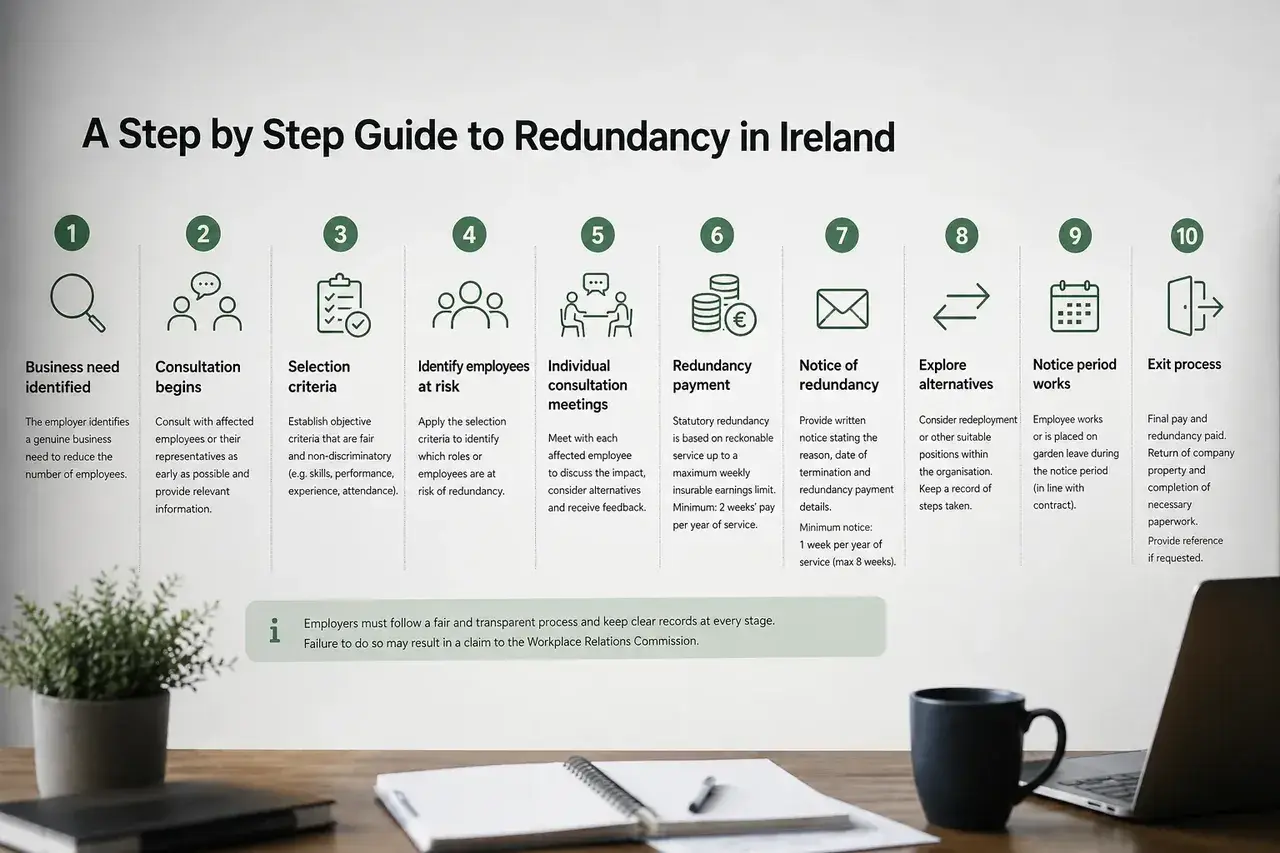
We also support employers on the consultation process, selection criteria, notification timelines, and the documentation that needs to exist at each stage. For businesses facing collective redundancies, where specific statutory notification duties apply, we manage that process end-to-end, including the notification to the Department of Enterprise, Tourism and Employment.
If a WRC claim follows a redundancy, our team handles representation and documentation preparation for adjudication hearings and WRC inspections. The earlier we are involved, the stronger the employer’s position when a claim eventually arrives.
Contact PurpleTree HR to speak with our employment advice team before you issue any redundancy notification. A brief conversation at the start of the process is a considerably better investment than managing an unfair dismissal claim at the end of it.
This article is for general informational purposes only and does not constitute legal advice. Employment law is complex and fact-specific. For advice on your specific situation, contact the PurpleTree HR team directly.
Genuine redundancy questions employers ask
On this page